Burpee

Activation
Muscles worked
Movement
Cardio
Intermediate · Bodyweight
Primary muscles
Movement pattern
Equipment category
How to perform
- 1
Set up
Stand with room to drop to the floor and jump.
- 2
Execute the movement
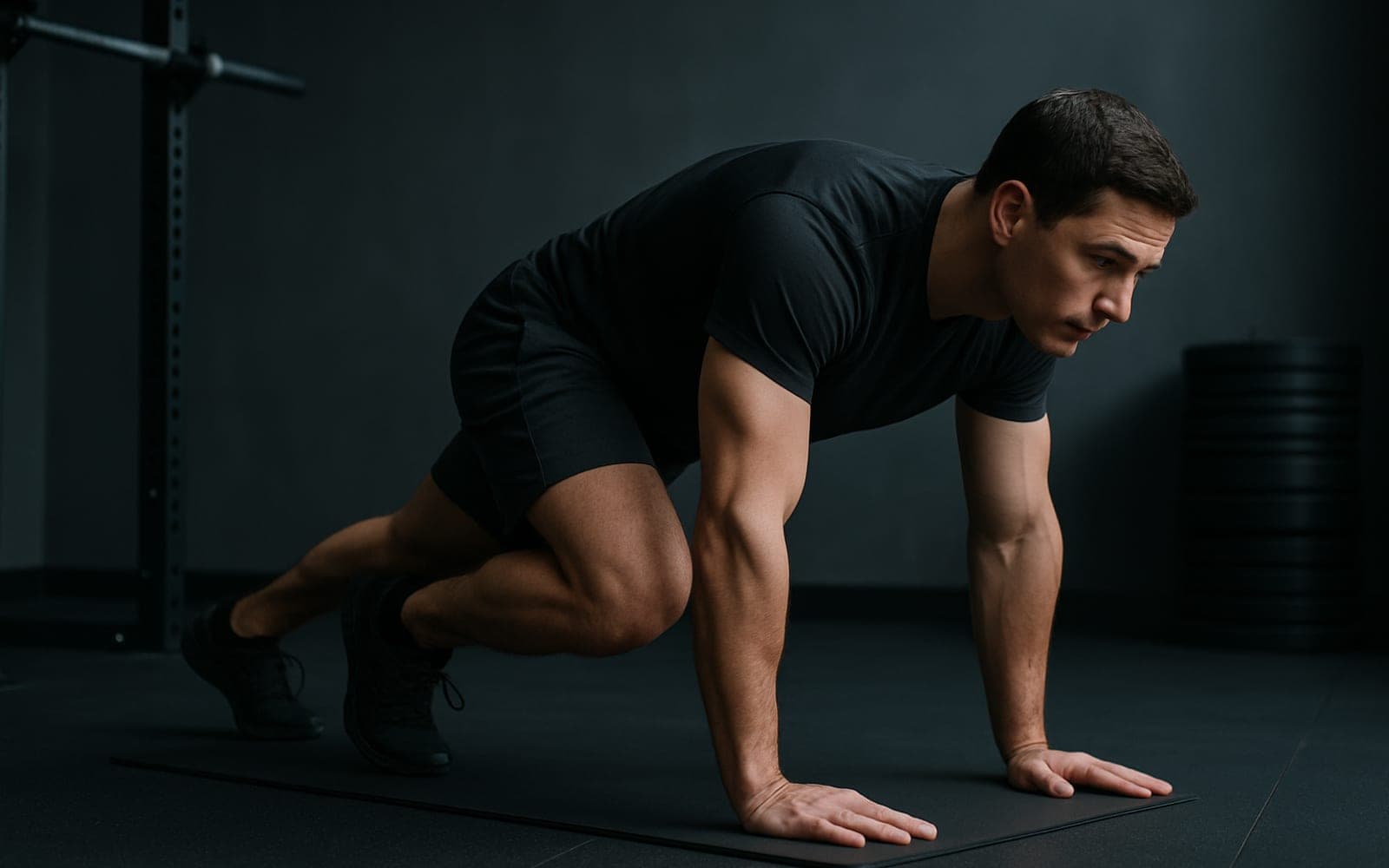
Squat down, kick the feet back to a plank, do a push-up (optional), hop the feet back in, then jump up. Keep a steady, repeatable pace.
Common mistakes
- Sagging hips in the plank
- Sloppy landings
- Going out too fast and gassing
Make it harder
Make it easier
Substitutions
If a machine is busy or unavailable, these train the same pattern a different way.
Your progress over time
What to expect from training this consistently — everyone progresses at their own pace.
- 1
First few sessions
You learn the sequence and timing (squat, plank, push‑up optional, return, jump), practice breathing, and complete small sets with focus on safe form and a noticeable rise in heart rate.
- 2
Weeks 2–4
Consistency allows you to string more reps together at a steady pace with cleaner transitions; work capacity and muscular endurance (quads, chest, shoulders, core) begin to improve and you can do longer intervals.
- 3
Months 1–3
Cardiovascular fitness and anaerobic tolerance increase, allowing higher rep sets and shorter rest; you’ll see modest improvements in body composition when paired with nutrition and greater comfort adding the push‑up or faster jumps.
- 4
Months 3–6
Significant conditioning gains: you can perform multiple rounds or EMOMs, increase intensity (faster pace, added tuck jump), and notice better recovery between efforts and improved explosive power.
- 5
6+ months
High work capacity and plyometric ability; you can use burpees as a challenging conditioning tool (e.g., long AMRAPs or HIIT sessions), sustain higher volumes, and see clear carryover to sport conditioning and overall fitness.
Benefits of the burpee
Develops full‑body conditioning by engaging legs, chest, shoulders, and core in a single compound movement.
Improves cardiovascular and anaerobic fitness through repeated high‑intensity intervals and sustained elevated heart rate.
Efficient calorie burner that supports weight‑loss goals when combined with proper nutrition due to its metabolic demand.
Builds explosive lower‑body power and coordination useful for running, changing direction, and sport‑specific movements.
Enhances core stability and trunk control because the plank and transitional phases require bracing and hollow‑body tension.
Time‑efficient, equipment‑free exercise that provides scalable intensity for both steady‑state cardio and high‑intensity interval training.
Exercises that pair with this
Same muscles or the same movement pattern — useful for building the rest of the session.


Burpee — questions people ask
What muscles does the burpee work?
The burpee trains the full body as the primary target, with the chest, quads, core working as support. It is a cardio pattern, so it also trains the coordination that pattern needs.
How many sets and reps of the burpee should I do?
Work in time, not reps: 20–40 minutes at a conversational pace for base fitness, or 6–10 short hard intervals with equal rest if you are training for speed.
Is the burpee good for beginners?
It is a reasonable second step. The burpee asks for some control and body awareness. Step (don't jump) the feet back and skip the jump. If it feels like too much, build the pattern on the mountain climber first.
What can I do instead of the burpee?
Mountain Climber all train the same cardio pattern with different equipment, so any of them works when the machine is busy or your gym does not have it.
What are the most common burpee mistakes?
Sagging hips in the plank; Sloppy landings; Going out too fast and gassing. Squat down, kick the feet back to a plank, do a push-up (optional), hop the feet back in, then jump up. Keep a steady, repeatable pace.